Guides · What to say
I'm sick of being the bad cop about screens. What can I do?
You say it's time to stop. They push back. Ten minutes later you are shouting, and you are the bad guy again. Here is why being the only off-switch in the house wears you down, and how to hand that job over.
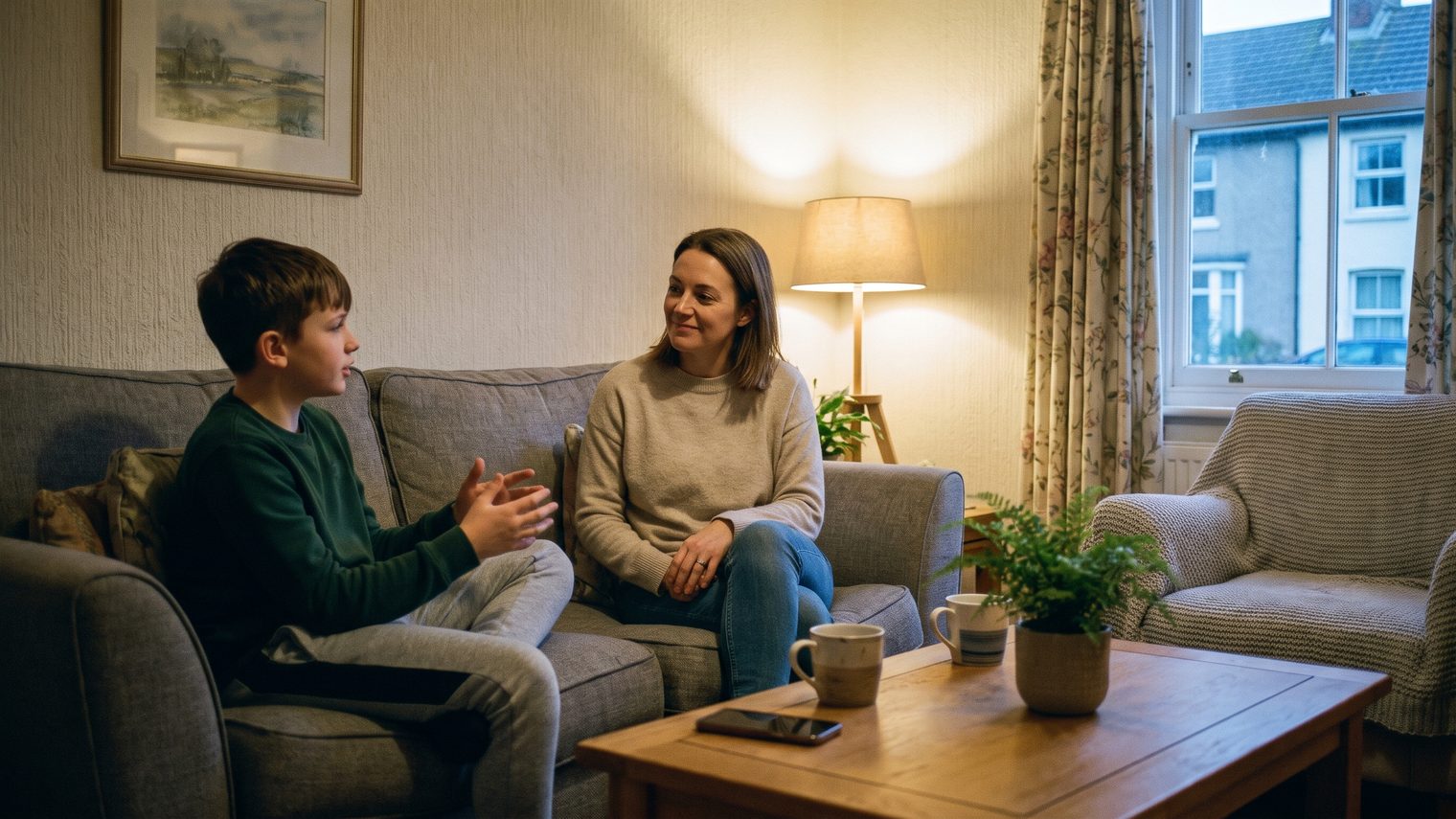
What to say
“That’s the time we agreed. If you want it changed, bring it up on Sunday.”
What to say at the stop, once the rule is agreed together
In short
Agree the rules together at a calm time, keep the stop the same every night, and let something other than you end the session.
Stop making the decision at the moment of stopping. Agree the rules with your child at a calm time, with their reasons heard. Keep the stop the same every night, and let a timer or an app call time. The row is rarely about the limit itself. People push back hardest when a freedom feels taken from them, and studies of teenagers link controlling rule-giving with defiance more than the rules themselves. You are far from the only one. In EE's survey of UK families with 11 to 17-year-olds, published in August 2025, 53% argue about screen time at least once a month. A small US study looked at families with children aged 1 to 5. Screen time ended more smoothly when the technology ended it than when a parent did.
Key facts
- 53% of UK families with 11 to 17-year-olds argue about screen time at least once a month (EE survey, August 2025).
- In 1,472 young people aged 12 to 21, controlling parenting went with more defiance, whatever the number of rules (Van Petegem and colleagues, 2015).
- With children aged 1 to 5, screen time ended more smoothly when technology ended it than when a parent did (Hiniker and colleagues, 2016).
It is half past eight. You say screens off. They say "in a minute". You say it again, louder. Now it is a row, and you are the bad guy for the third night running. Parents put it plainly: "I'm always the bad guy." "Every evening ends in a row." "I'm the only off-switch in the house."
You are not doing it wrong. You have ended up holding a job that sets you up to lose, every night, on your own. The fix is to hand most of that job to something else.
Why does every evening end in an argument about screens?
Because the stop feels like something being taken away, and you are the one taking it.
In 1966 the psychologist Jack Brehm described reactance. When people feel a freedom is under threat, they get a strong urge to win it back. A 2015 review of the research adds a detail that matters at home. Commanding words like "must", "should" and "need" set it off more than softer words do.
Children are no different. A 2015 study in Child Development looked at 1,472 young people aged 12 to 21. Young people who saw their parents as controlling felt their freedom was squeezed, and that went with more defiance. The link held even after allowing for how many rules the parents set. Most of this research is surveys, so it shows that these things go together. It cannot show that one causes the other. Still, the pattern is clear. Children push back against being controlled more than against the limit itself.
So the nightly row is rarely about whether half past eight is fair. It is about who decides, right then, in the middle of a game.
Why does it wear me down so much?
Because you are making the same decision every night, in the worst possible moment, with the least possible help.
Each evening you have to notice the time, say it, hold it, and absorb the reaction. If you give in, the next night is harder. If you hold firm, you are the enemy. Neither feels good, and it repeats.
You have plenty of company. EE surveyed 2,000 UK parents of 11 to 17-year-olds and published the results in August 2025. 53% of families argue about screen time at least once a month. In the same survey, 39% of parents and 31% of children said clearer rules would cut the arguments. Your child may want this sorted as much as you do.
What actually helps?
Five changes, each one taking a little of the job off you.
- Agree the rules at a calm time, with your child's say. A weekend afternoon works better than a school night. A 2008 review by Joussemet, Landry and Koestner looked at how parents set limits. The same limit landed very differently depending on how it was given. Limits that came with reasons, an acknowledgement of feelings and some real choice kept children's motivation intact. Controlling delivery did not.
- Make the stop the same every night. A fixed time on school nights, and a different fixed time at weekends if you like. When the rule never moves, there is nothing to win by arguing. The same review links clear, consistent structure to children doing well.
- Give a heads-up they can use. Be careful here, because the evidence is mixed. A University of Washington study looked at families with children aged 1 to 5. A two-minute warning from a parent made children more upset at the end. What helped was stopping at a natural break, such as the end of an episode. No study we found has tested warnings with children of 8 to 14. The useful part for an older child is time to reach a natural break, like the end of a match.
- Let something other than you end the session. The same study was presented at the CHI conference in 2016. Children were less upset when the technology ended screen time than when a parent did. A flat battery or a dropped wifi signal caused fewer tantrums than a parent saying stop. It was a small study of toddlers and preschoolers, so treat it as a strong hint. A kitchen timer, the phone's own time limit, or an app can all do the stopping.
- Share the job with the other adult. If there are two parents, agree the rule together and both say the same thing. Take turns doing the evening stop. If you are on your own, the written rule and the timer are your second adult.
What do I say at the calm talk?
Pick a time when nobody is on a screen and nobody is tired. Keep it short. These lines help.
- "Every evening ends in a row about screens, and I hate it. I don't think you like it either."
- "I want us to agree the rules now, while we're both calm, so we don't fight about it at bedtime."
- "What do you think is fair on a school night? Tell me your reasons and I'll tell you mine."
- "Let's write it down. Then neither of us has to argue about it later."
- "We'll try it for two weeks. If it isn't working, we'll change it together."
Listen more than you talk. If their idea is reasonable, use some of it. A rule they helped write is one they are more likely to keep. Our guide to writing a family screen time agreement walks through it step by step, and there is a free agreement to fill in together.
What do I say at the stop?
Say less. The rule is already agreed, so you are only pointing to it.
- "That's the time we agreed."
- "I know it's hard to stop mid-match. Finish this one, then it's off."
- "If you want it changed, bring it up on Sunday when we look at it again."
Then stop talking. Explaining again reopens the argument. If they push back, repeat the first line once, calmly. For more on the moment itself, read what to say to "five more minutes".
If it is already a row, let tonight go. "We'll talk about it tomorrow" is enough. Come back to it when everyone is calm.
What if it doesn't get better?
Give it two weeks. The first few nights are often harder, as your child checks whether the new rule is real.
If the rows keep coming, check two things. Is the rule one your child had a real say in? And are you the one still enforcing it every night? If both answers point to you, hand over more of the job. It also helps if the grown-ups follow screen rules too. Our guide on the same screen rules for parents covers that.
If arguments turn aggressive, or your child seems unhappy or withdrawn well beyond screen time, talk to their school or your GP.
You don't have to win the argument every night. You only have to agree the rule once, together, and then let something else do the saying.
Kairoo
Let Kairoo be the one who says it.
You and your child agree the limit and both sign it. Kairoo gives the heads-up and holds the limit, with a reason for every no. If your child wants more, they ask Kairoo, with a reason.


Your phone and your child’s don’t have to match. Kairoo works between iPhone and Android, and your child’s app is also available on iPad.
Or start with the free agreement · Free, no card needed.
Questions parents ask
- Why does my child argue every time I say screens off?
- Because the stop feels like something being taken away by you. The psychologist Jack Brehm called this reactance in 1966: when people feel a freedom is threatened, they are driven to win it back. A 2015 review in Zeitschrift für Psychologie adds that commanding words like "must" and "need" set it off more than softer ones. The push-back is aimed at the control more than at the limit.
- How do I stop being the bad guy about screen time?
- Move the decision away from the moment of stopping. Agree the rules with your child at a calm time, explain your reasons and hear theirs, and write them down. A 2008 review by Joussemet, Landry and Koestner in Canadian Psychology looked at how limits are given. The same limits, given with reasons, empathy and some choice, kept children's motivation intact. Controlling delivery did not.
- Should I give a warning before screen time ends?
- The evidence is mixed. A University of Washington study, presented at CHI 2016, looked at families with children aged 1 to 5. A two-minute warning from a parent made children more upset at the end. Stopping at a natural break, such as the end of an episode, helped. No study we found has tested warnings with children of 8 to 14.
- Is it better if a timer or app ends screen time instead of me?
- In one small study, yes. Researchers at the University of Washington followed families with children aged 1 to 5, and reported at CHI 2016. Children were less upset when the technology ended the session than when a parent did. A flat battery is one example. Older children have not been tested in the same way, so treat it as a strong hint.
- How common are arguments about screens in UK families?
- Very common. EE surveyed 2,000 UK parents of 11 to 17-year-olds and 2,000 children, and published the results in August 2025. 53% of families argue about screen time at least once a month. In the same survey, 39% of parents and 31% of children said clearer rules would reduce the arguments.
Read next
Sources
- EE launches new free P.H.O.N.E. Contract designed to help parents and children set smartphone boundaries ahead of the new school year, EE newsroom, 12 August 2025
- Understanding psychological reactance: new developments and findings, Steindl, Jonas, Sittenthaler, Traut-Mattausch and Greenberg, Zeitschrift für Psychologie 223(4), pages 205 to 214, 2015
- Rebels with a cause? Adolescent defiance from the perspective of reactance theory and self-determination theory, Van Petegem, Soenens, Vansteenkiste and Beyers, Child Development 86(3), pages 903 to 918, 2015
- A self-determination theory perspective on parenting, Joussemet, Landry and Koestner, Canadian Psychology 49(3), pages 194 to 200, 2008
- Screen time tantrums: how families manage screen media experiences for toddlers and preschoolers, Hiniker, Suh, Cao and Kientz, Proceedings of CHI 2016 (ACM), pages 648 to 660, May 2016
- Two-minute warnings make kids' screen time tantrums worse, University of Washington News, 5 May 2016
Last reviewed 25 October 2026. Kairoo checks these pages when the rules or the research change; if you spot something out of date, tell us at hello@kairoo.family.