Guides · How to
Should I follow the same screen rules as my kids?
"You're on yours all the time." It lands because it's partly true. Here is what the research says about parents' own phone use, why a rule that applies to everyone holds better, and how to set one without giving up your evenings.
Key fact
4h 30m
a day, roughly, that UK adults spend online outside work, most of it on a phone
In short
Yes for the places and times, like phones away at the table and out of bedrooms at night; the amounts can differ between you.
Yes, for the places and the times. Not for the amounts. Phones away at the table, charging outside the bedroom overnight, and nobody on a phone during the thing the family is doing together: those rules should apply to you as well, and your child will hold you to them. How much time a nine-year-old and a parent spend on screens can differ, and you can say why. The research gives two reasons to bother. A longitudinal study of 183 families found that parents' phone use interrupting family time went with more whining, sulking and tantrums in their children, and the effect ran both ways. And rules children see as fair are the ones they keep; a rule that applies to the person setting it is the fairest kind. UK adults spend about four and a half hours a day online outside work, so the gap between what we say and what we do is not small.
Key facts
- Parents' phone use interrupting family time went with more whining, sulking and tantrums in a six-month study of 183 families (McDaniel and Radesky, Pediatric Research, 2018).
- UK adults spend about 4 hours 30 minutes a day online outside work, most of it on a phone (Ofcom, Online Nation 2025).
- 55% of parents think their child's screen time is too high; 37% of 8 to 17-year-olds think the same about themselves (Ofcom, 2026).
It usually comes out at the table. You ask for the phone to go away and get "you're on yours all the time" back. Or it comes out at bedtime, when you take theirs upstairs and yours stays in your hand. The accusation stings because it is partly fair. We ask children to do something at eight that we don't manage at nine. The question is whether that matters, and the evidence says it does.
Does my phone use actually affect them?
Yes, and the effect runs in both directions. Researchers at Illinois State University and the University of Michigan followed 183 families with a young child for six months, asking parents how often their phones and devices interrupted time with their child and how the child was behaving. They published the results in Pediatric Research in 2018. More interruptions went with more externalising behaviour: whining, sulking, tantrums, acting out. Difficult behaviour, in turn, raised parents' stress and their reaching for the phone. The researchers call it technoference.
It is an association in a study of younger children. It is not proof of cause in yours. But it matches what most parents can see: a child talking to the top of your head gets louder, and you reach for the phone more on the days that are hardest.
How much are we actually on them?
More than we think. Ofcom's Online Nation report for 2025 puts the average UK adult's time online, outside work, at about four hours 30 minutes a day, most of it on a smartphone, and over six hours for adults aged 18 to 24. In Ofcom's 2026 research on children, 55% of parents said their child's screen time was too high, and 37% of 8 to 17-year-olds said the same about their own.
Put the two together and the child's complaint has a number behind it. The adult asking for the phone to go away is often the heaviest user in the room.
Why a rule for everyone holds better
Two reasons, one from the research and one from the kitchen.
The research on how children come to keep rules says the rules that stick are the ones they understand and accept as fair. A rule explained with a reason, applied the same way each time, is internalised. A rule that is "because I said so" is obeyed while you are watching. A rule that the person setting it visibly breaks is neither; it is a double standard, and children are precise about those.
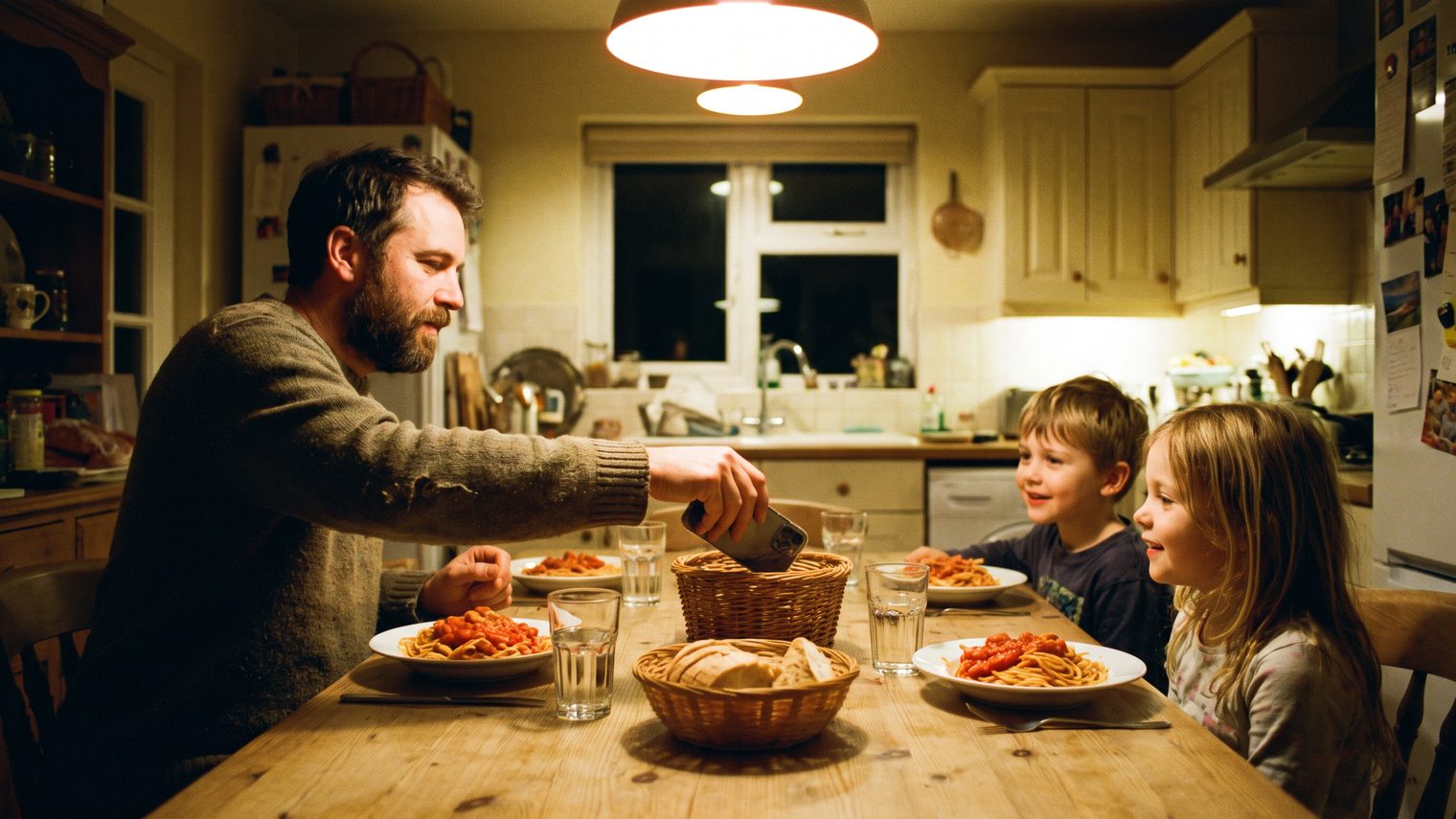
The kitchen reason is simpler. "Phones away at dinner" said by someone whose phone is on the table is an instruction. Said by someone who has just put theirs on the shelf, it is a description of what this family does. The second kind needs far less enforcing.
The UK's Chief Medical Officers made the same point in their 2019 advice to parents without saying it in those words: screen-free mealtimes, phones out of bedrooms at night, talking about what everyone is doing online. None of that advice has an age limit.
What a fair rule looks like
Fair does not mean identical. It means the same places and the same times, with any difference in amounts explained.
- Same places. No phones at the table, for anyone. No phones in bedrooms overnight: theirs charges in the kitchen, so does yours.
- Same times. During the thing the family is doing together (dinner, the film, the walk) nobody is on one. If you need to check something, say so and step away, then come back.
- Different amounts, with reasons. A parent has work messages and a nine-year-old doesn't. Say it plainly: "I check work at eight for ten minutes, then it goes away." A rule your child can watch you keep is a rule they will hold you to, which is the point.
- Written down, by both of you. The promises go both ways, and the parent's promises are on the same sheet as the child's.
What to do tonight
- Ask what they've noticed. "When do you think I'm on my phone too much?" Expect an answer. It will probably be dinner and bedtime.
- Pick the two places. The table and the bedroom. Agree that the rule is for everyone.
- Put your phone where theirs goes. Tonight, charging outside the bedroom, next to theirs. Say out loud that you are doing it.
- Name your exception. If you have one, make it small and visible: a time, a length, a place.
- Write it on the same sheet. The child's promises and yours, both signed.
What changes
The arguments at the table shorten, because the reply "you're on yours" no longer works. Bedtime gets easier for the same reason. And something quieter happens: you find out how often you were reaching for the phone, because the child is now the one pointing it out. Most parents who try this report that part as the uncomfortable bit and the useful bit.
Watch for drift. The exception grows if it isn't named. If "ten minutes for work" becomes half an hour on the sofa, say so first, before your child does.
To put both sides' promises into one written agreement, read how to write a family screen time agreement. For the overnight rule and the evidence behind it, read screens before bed.
Kairoo
The rules they signed. And the ones you signed back.
In Kairoo the agreement has promises both ways. You and your child write it together and both sign it, and the phone at dinner is in there for both of you.


Your phone and your child’s don’t have to match. Kairoo works between iPhone and Android, and your child’s app is also available on iPad.
Or start with the free agreement · Free, no card needed.
Questions parents ask
- Does my phone use really affect my child?
- The best evidence says yes, in both directions. A study published in Pediatric Research in 2018 followed 183 families for six months. When parents reported more interruptions of family time by their phones and devices, their children showed more externalising behaviour such as whining, sulking and tantrums. Difficult behaviour also raised parents' stress and their phone use. It is an association rather than proof of cause, but it is the pattern parents describe.
- How much time do adults spend on their phones?
- Ofcom's Online Nation 2025 report puts UK adults' time online at about four hours 30 minutes a day, outside work, most of it on a smartphone. Adults aged 18 to 24 average over six hours. Ofcom's 2026 research on children found 55% of parents think their child's screen time is too high, and 37% of 8 to 17-year-olds think the same about themselves.
- Do the rules have to be identical?
- No. The places and the times should match: no phones at the table, phones out of bedrooms overnight, no phones during the thing you are doing together. The amounts can differ by age, and you should say why. Children accept a difference they understand; they resent one that is never explained.
- What if I need my phone for work in the evening?
- Say so, and make it specific. "I check work messages at eight for ten minutes, at the kitchen table, then it goes on the shelf" is a rule your child can see you keep. "I have to be on it, it's work" is a loophole, and children find loopholes faster than parents do.
- Isn't it my phone and my decision?
- It is. The question is what you want the rule to do. If the aim is a child who can put a phone down at the table and at bedtime, the fastest way to teach it is to be seen doing it. Children copy what the adults around them do far more than what they are told.
Read next
Sources
- Technoference: longitudinal associations between parent technology use, parenting stress, and child behavior problems, Pediatric Research (McDaniel and Radesky), 2018
- Online Nation 2025, Ofcom, 10 December 2025
- Children and Parents: Media Use and Attitudes Report 2026, Ofcom, 21 May 2026
- UK CMO commentary on screen time and social media map of reviews, Department of Health and Social Care (UK Chief Medical Officers), 7 February 2019
- A Self-Determination Theory Perspective on Parenting, Joussemet, Landry & Koestner, Canadian Psychology 49(3), 194–200, 2008
- How to Make a Family Media Use Plan, HealthyChildren.org (American Academy of Pediatrics)
Last reviewed 25 October 2026. Kairoo checks these pages when the rules or the research change; if you spot something out of date, tell us at hello@kairoo.family.