“Five more minutes.”
You shouldn’t have to be the bad cop in your own home.
Kairoo holds the screen time limits you and your child agree on together. The bedtime argument stops being yours.
You’re in. Kairoo for iPhone is ready.
Download on the App Store →Start with Kairoo Parents on your phone; it shows you when to add your child’s. The three-minute set-up and the agreement are on their way to your inbox.
You’re on the list. Android is coming soon.
We’ll email you the day it’s ready. The agreement is on its way to your inbox, and it works on paper tonight. Got an iPhone too? Get it here.
No surveillance. Built in the UK with Nesta.
Tonight, this is happening in
millions of homes.
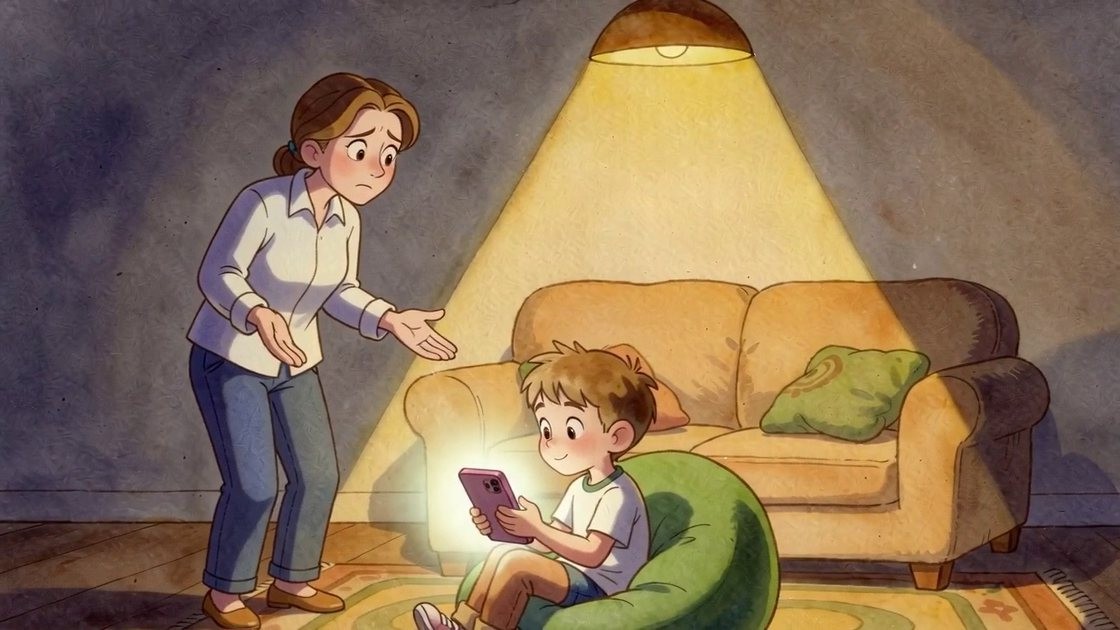
“Get off your phone.” “In a minute.” …nothing.
And somehow, every ask
ends with you.
You’re the only off-switch in the house.
Stop being
the screen-time police.
Nobody signed up for the nagging.
When it’s time,
Kairoo says it. Not you.
The deal you both signed does the saying.
So they stop
by themselves.
Phone down. Boots on.
Help your child build
healthy digital habits.
Calmer evenings for you. Self-control for them.
You shouldn’t have to be the bad cop in your own home.
Kairoo holds the screen time limits you and your child agree on together. The bedtime argument stops being yours.



Same rules. Somebody else holding them.
The rules don’t change. Who holds them does: the same limits, held by Kairoo instead of by you.
Drag the handle. Same room, same night.

 Without Kairoo
| Rules held by a parent | Kairoo | |
|---|---|---|
| Who wrote it | You, alone | You and your child, together |
| At the limit | A wall, or an argument | A choice: bank it, ask, or spend it |
| Does it flex? | Only when you cave | Adapts to the day, inside your rules |
| Who says no | You. Every time. | Kairoo. With a reason. |
| What they learn | How to get round it | How to stop |
How this compares with Screen Time, Family Link, Qustodio and the rest, product by product: the full comparison.
Kairoo takes the bad cop. You keep the good bits.
Every single layer of your child’s digital life works for a platform. Not one of them works for your family.
The laugh, the lift, the chat at the end of the day. Those are yours again.
An agreement you both sign. And someone neutral to keep it.
Kairoo is the screen time agreement you and your child both sign, and the app on both your phones that holds it. It is for families with a child aged around eight to fourteen, on iPhone today (Android is on the way). Kairoo holds the rules you both agree, so that you don’t have to. You sit down together, in about ten minutes, write the agreement and both sign it. From then on Kairoo acts inside that boundary on your behalf: the reminding, the negotiating, the explaining, the holding of the line. You stop being the bad cop, and your child gets a safe space to practise agency. Privacy first: it sees time and apps, not messages or location. Built in the UK with Nesta.
Kairoo isn’t a wall you put up around your child. It’s a referee you both agree to. You sit down together and decide what the evening looks like, and your child has a real say in it.
You get to stop being the one who says no and go back to being their parent.
The Hartley Family Agreement (an example)
✓ signed
Ten minutes to set up. Then it’s not your job.
- 1
Agree it together
About ten minutes, once. What matters to your family, when screens start and stop, how long, and which apps. Your child helps write it. That part isn’t a nicety. It’s the reason the whole thing works.
- 2
Kairoo holds the line
Gentle reminders as the limit gets close, then it does what you agreed. Your child takes it up with Kairoo, not with you. Every “no” comes with a reason: what was asked for, what the agreement says, how today’s time was spent.
- 3
Freedom grows as trust does
At every reminder your child chooses: stop now and bank the minutes, ask for more, or carry on and spend it. The goal is a child who can stop on their own. They can ask Kairoo for a change to the agreement itself. Stopping well earns a wider agreement, and one day they don’t need us any more.
You and your child, on the same team. That’s how self-control grows.
Rules handed down get tested. Rules your child helped write get kept. Bring them in and the evening stops being you against them: limits you agreed together, and inside them they practise stopping on their own. That is where self-control comes from, and what lets you step back.
The apps built from a parent’s fear alone get one star from three in four of the children who review them. Kairoo is built for both of you.
Ghosh et al., CHI 2018: 736 Google Play reviews written by children aged 8 to 19, of 37 parental control apps. 76% gave one star. doi:10.1145/3173574.3173698
Alongside calmer evenings for you, your child gets:
- A say in the rules. They help write them, and they sign them.
- Limits that are predictable. The same rule tonight as last night. No mood, no negotiating, no “because I said so.”
- A proper way to ask. Not begging a tired parent. A request, with an answer and a reason.
- Somewhere to be annoyed that isn’t you. Being cross with an app costs your relationship nothing.
- More freedom, earned. Handle it well, get more of it.
“It reminds me sweetly. More sweeter than a parent.”
Another child, thirteen. He asked to sign the agreement his dad had skipped.
Hundreds of tiny decisions. They don’t all belong to you.
Pick one and watch it land on both phones.
Tap one to watch the same evening from both phones.
40 of 60 minutes used · screens down at 9:00
The everyday. Ten more minutes, with fifteen spare under the agreement. Kairoo says yes, sets the time to be back by, and nudges two minutes before. Answered by the deal you both signed. Nothing reached Mum’s phone, and nobody had to be the bad cop.
The grey areas. Thirty more minutes for a tournament, when the agreement caps extra time at ten. Homework’s done, so Kairoo gives the ten, tells your child why it’s ten and not thirty, and lets you know. A middle-sized call, made inside your ceiling and explained to both of you. It lands on your phone as news, not as a job.
The ones that matter. A new app, which sits outside the agreement. Kairoo doesn’t decide this one. It gathers the context, hands you the decision, and delivers your answer in your words.
Sixty years of research. One idea.
Kairoo rests on eight bodies of research: procedural justice, reactance, self-determination, authoritative parenting, screen-time transitions, imposed monitoring, commitment devices and scaffolding. This isn’t a hunch about children. It’s a well-evidenced idea nobody had built into the moment it’s needed.
- 01
Procedural justice
People accept an outcome they dislike when the process is fair: a say, a neutral decider, the same rule every time, and a reason given.
Thibaut & Walker 1975 · Tyler 1990 - 02
Reactance
Children push back against being controlled far harder than against the limit itself. Move the limit off the parent and the fight mostly goes.
Brehm 1966 - 03
Self-determination
Rules are internalised where there is autonomy. Controlling settings buy compliance, not internalisation.
Deci & Ryan 1985, 2000 · Grolnick 2003 - 04
Authoritative parenting
Warmth and structure produce the best outcomes. Either one alone does worse, and they need not come from the same place.
Baumrind 1966, 1991 · Steinberg 2001 - 05
Screen-time transitions
Ending a session goes measurably better when the technology ends it than when a parent does.
Hiniker et al., CHI 2016 (children aged one to five) - 06
Imposed monitoring
Children reject imposed monitoring, and try to get round it. Three in four child reviews of parental control apps give one star.
Ghosh et al., CHI 2018 - 07
Commitment devices
Adults already pay a third party to hold them to their word, because it will not renegotiate. Families have never had the two-party version.
Bryan, Karlan & Nelson 2010 - 08
Scaffolding
Support is given, then withdrawn step by step as competence grows. A ladder, not a timer.
Wood, Bruner & Ross 1976 · Vygotsky 1978
The full references
- Thibaut, J. W. and Walker, L. (1975). Procedural Justice: A Psychological Analysis. Lawrence Erlbaum. Thibaut, J. and Walker, L. (1978). A theory of procedure. California Law Review, 66. doi:10.2307/3480099. Tyler, T. R. (1990). Why People Obey the Law. Yale University Press. Tyler, T. R. (2006). Psychological perspectives on legitimacy and legitimation. Annual Review of Psychology, 57. doi:10.1146/annurev.psych.57.102904.190038
- Brehm, J. W. (1966). A Theory of Psychological Reactance. Academic Press.
- Deci, E. L. and Ryan, R. M. (1985). Intrinsic Motivation and Self-Determination in Human Behavior. Plenum. doi:10.1007/978-1-4899-2271-7. Ryan, R. M. and Deci, E. L. (2000). Self-determination theory and the facilitation of intrinsic motivation, social development, and well-being. American Psychologist, 55(1). doi:10.1037/0003-066X.55.1.68. Grolnick, W. S. (2003). The Psychology of Parental Control: How Well-Meant Parenting Backfires. Lawrence Erlbaum. doi:10.4324/9781410606303
- Baumrind, D. (1966). Effects of authoritative parental control on child behavior. Child Development, 37(4). doi:10.2307/1126611. Baumrind, D. (1991). The influence of parenting style on adolescent competence and substance use. Journal of Early Adolescence, 11(1). doi:10.1177/0272431691111004. Steinberg, L. (2001). We know some things: parent-adolescent relationships in retrospect and prospect. Journal of Research on Adolescence, 11(1). doi:10.1111/1532-7795.00001
- Hiniker, A., Suh, H., Cao, S. and Kientz, J. A. (2016). Screen time tantrums: how families manage screen media experiences for toddlers and preschoolers. CHI 2016. doi:10.1145/2858036.2858278
- Ghosh, A. K., Badillo-Urquiola, K., Guha, S., LaViola, J. J. and Wisniewski, P. J. (2018). Safety vs. surveillance: what children have to say about mobile apps for parental control. CHI 2018. doi:10.1145/3173574.3173698
- Bryan, G., Karlan, D. and Nelson, S. (2010). Commitment devices. Annual Review of Economics, 2. doi:10.1146/annurev.economics.102308.124324
- Wood, D., Bruner, J. S. and Ross, G. (1976). The role of tutoring in problem solving. Journal of Child Psychology and Psychiatry, 17(2). doi:10.1111/j.1469-7610.1976.tb00381.x. Vygotsky, L. S. (1978). Mind in Society. Harvard University Press.
The eight ideas above are the research. How Kairoo builds on them is our own inference, not a finding of the researchers named.
None of this is new. What’s new is that somebody finally built all eight into the thirty seconds where the argument happens. How, exactly, is the product.
We are not watching your child.
Kairoo doesn’t read their messages, log what they watch, or show you a feed of their activity. We’re not a monitoring product and we never will be.
No surveillance
Your child knows exactly what Kairoo can see, because they signed it.
Your data stays yours
Not sold, not shared, not used for advertising. Ever.
No ads
We will never make money from your family’s data. That’s the whole business.
Registered with the ICO
And built to the Children’s Code.
Free, and no card.
Kairoo is free for every family. Learning to manage your own screen use shouldn’t be a skill only some children get.
Go on, then.
“Won’t my child just find a way round it?”
Some will try. In our pilot, children made well over a hundred attempts between them, and we fixed dozens of holes because of them. But here’s what surprised us: the attempts fell off night after night. Not because we blocked every route. Because they’d signed the thing. One girl who’d added twelve hours to her own limit on the built-in controls stopped bothering once the rules were partly hers.
“Is this spying?”
No. Kairoo sees time and apps against an agreement your child signed. It doesn’t read messages, track location, filter content, or report on what they watch. If you want a surveillance product, there are several. This isn’t one.
“My child doesn’t have their own phone yet.”
Then you’re early, which is a good place to be. Do the first phone readiness check, join the list, and start with the agreement before the first phone arrives.
“What if they refuse to sign?”
Most children come round once they see what is in it for them: a say in the rules, the same limit every night, and more freedom as they show they can handle it. If yours digs in, start with the conversation rather than the app, and we’ll send you the one we use to open it. A rule a child helped write gets kept. A rule imposed on them gets tested, which is why Kairoo works the way it does.
“What about tablets, consoles, the TV?”
Coming. Half our pilot families asked for it unprompted. Today it’s phones.
“What happens when they get older?”
Kairoo steps back. As your child shows they can handle bedtime themselves, it stops managing bedtime and takes on whatever the next thing is. Success is your child not needing it.
“Is it another thing for me to manage?”
About ten minutes to set up. After that it should be silent unless something needs you.
“Isn’t this just another parental control app?”
No. A parental control is a wall you put up around your child, and you hold it. Kairoo is a referee you both agree to. Your child helps write the rules and signs them. At the limit there’s a choice, not a wall: bank it, ask, or spend it. Kairoo says the no, with a reason. What they learn is how to stop, not how to get round it.
“What age is Kairoo for?”
Children aged around eight to fourteen: old enough to have a say in the agreement and to practise keeping it, young enough that the evening is still yours to shape. That’s a child with their own phone, or one who’s about to get one; the children quoted on this page are eleven and thirteen. Older or younger, join the list anyway and tell us their age when we ask; some families outside that range will suit the next group.
“Does Kairoo work on iPhone or Android?”
iPhone today, and it’s on the App Store now: two apps, Kairoo Parents on your iPhone and Kairoo on your child’s own iPhone or iPad, linked by a one-time pairing code. Android is being tested by families now; join the Android list and we’ll email you the day it’s ready. Tablets, consoles and the TV are coming; half our pilot families asked for them unprompted. If you want to check your handset before you join, email hello@kairoo.family and ask.
“Can my child ask for more time without it landing on me?”
They ask Kairoo, with a reason. If the agreement has room, Kairoo says yes and nothing reaches your phone. Over the ceiling you set, Kairoo decides inside it, explains why to your child, and tells you afterwards: news, not a job. Anything outside the agreement, like a new app, comes to you with your child’s reason attached, and Kairoo delivers your answer in your words.
“What goes in the agreement?”
Whatever matters to your family: when screens start and stop, how long, which apps, how extra time gets asked for. The example above: screens finish at 9:00 on school nights, 9:30 at weekends. Homework and jobs first, then games unlock. Extra time can be asked for, with a reason; ten minutes is the ceiling. New apps come to Mum or Dad. Both of you sign it. Write yours, screens and the rest of the internet, on paper or on the phone, at kairoo.family/agreement.
“Does it work, though?”
Honest answer: early. What we saw in our pilot: the workaround attempts fell off night after night, and a thirteen-year-old asked to sign the agreement his dad had skipped. Those are observations, not measured results. The mechanism itself rests on sixty years of research across eight bodies of work, set out in the science section above.
“Who’s behind this, and are you in the UK?”
A small UK team based in London, building Kairoo in partnership with Nesta, the UK’s innovation agency for social good. Registered with the ICO and built to the Children’s Code. Families anywhere are welcome on the list: we take groups on a few at a time and tell you when it’s your turn, wherever you are.
“How do I get it, and when?”
Leave your email at the bottom of this page and we’ll show you the iPhone app straight away, with the set-up and the agreement. You get a welcome email now and a few short notes on getting started, nothing else, and unsubscribe is in every message. On Android, we’ll tell you the day it’s ready.
A child in charge of their own screen time. A parent who doesn’t have to be.
Built in partnership with Nesta, the UK’s innovation agency for social good.
You’re in. Kairoo for iPhone is ready.
Download on the App Store →Start with Kairoo Parents on your phone; it shows you when to add your child’s. The three-minute set-up and the agreement are on their way to your inbox.
You’re on the list. Android is coming soon.
We’ll email you the day it’s ready. The agreement is on its way to your inbox, and it works on paper tonight. Got an iPhone too? Get it here.
No surveillance · unsubscribe in every email
Nobody else offers to take the nightly argument off your plate. The first families have handed it over. Kairoo is on the App Store now.
“Kairoo is the bad cop now. It’s a relief: exactly what I wanted.”