Guides · How to
A first phone contract: what to agree before you hand the phone over
The phone is bought, or about to be. Christmas or the birthday is close. Once it is in their hand, every rule you add later will feel like something taken away.
Key fact
83%
of UK 11-year-olds have their own mobile phone, up from 56% at 10
In short
Agree the rules the week before, set the phone up together, and both sign one page before it is used for the first time.
Agree the rules before the phone arrives, while nothing has been given and nothing can be taken away. For most UK children the first phone comes at 10 or 11. Ofcom's 2026 research found phone ownership rises from 56% of 10-year-olds to 83% of 11-year-olds. A first phone agreement covers where the phone sleeps, which apps come first, when screens stop and how new apps get agreed. It also says what happens if something goes wrong, with a promise that telling you never costs the phone. Set the phone up together, sign the page, then hand it over. Families want clearer rules: in EE's 2025 survey, 39% of UK parents said clearer guidelines would reduce family friction.
Key facts
- Phone ownership jumps from 56% at 10 to 83% at 11 (Ofcom, 2026).
- 39% of UK parents and 31% of 11 to 17-year-olds say clearer guidelines would reduce family friction (EE, 2025).
- Leave phones outside the bedroom at bedtime and keep meals screen-free (UK Chief Medical Officers, 2019).
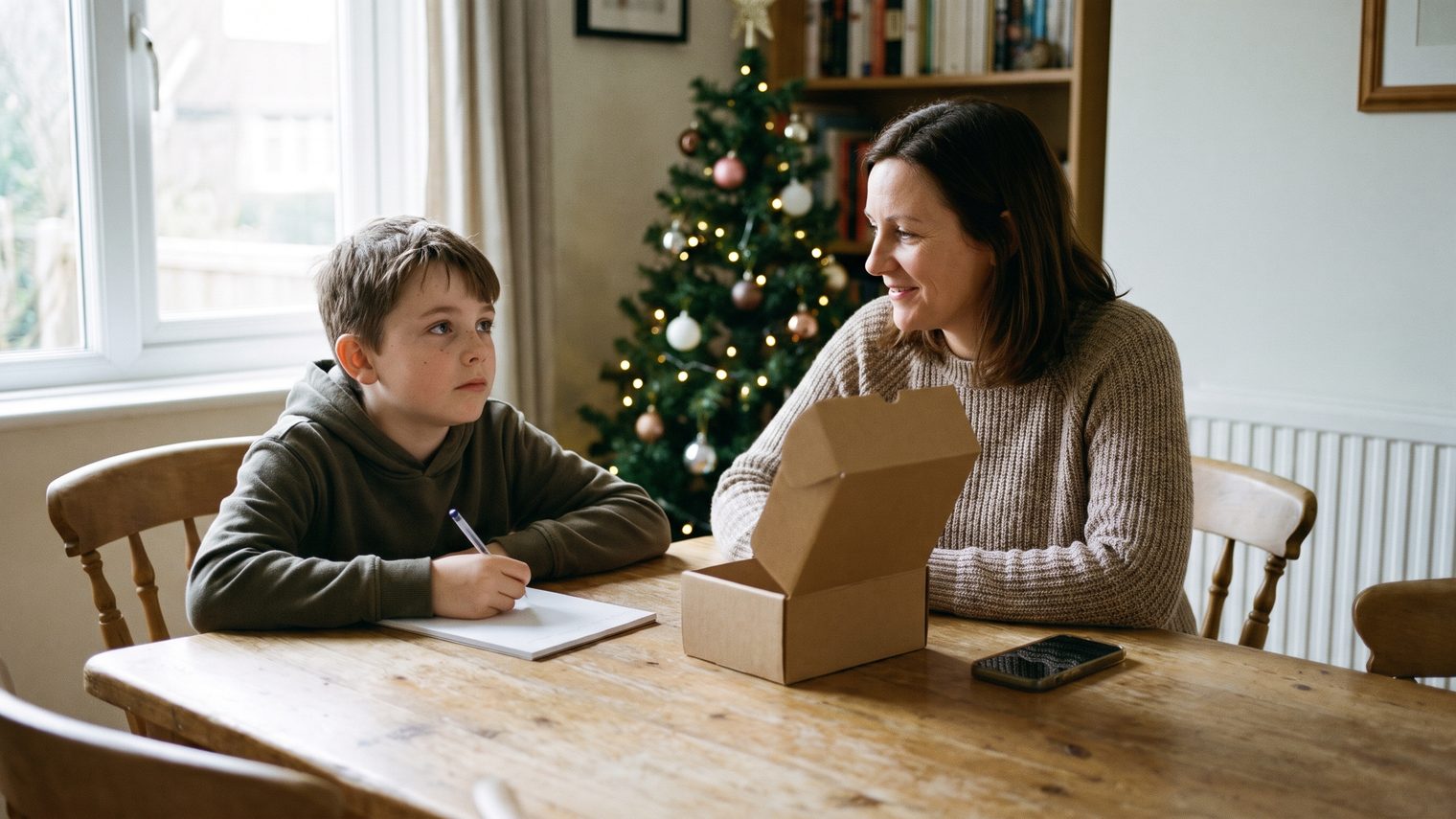
Parents often call it a first phone contract. Kairoo calls it an agreement, because you write it together and both sign it. The timing matters more than the wording. The phone is bought, or about to be. It might be wrapped under the tree, or saved for a birthday. On the day, your child will want to open it, switch it on and message everyone they know. Any rule you add after that will feel like something taken away. Any rule agreed before it comes with the phone.
When should we agree the rules for a first phone?
Before it is switched on for the first time. The week before is ideal.
Many families leave it late. EE surveyed 2,000 UK parents in 2025. Of those buying a phone before the new school year, 43% planned to buy it in mid to late August. That leaves days to agree anything. Christmas and birthdays can bring the same rush.
The same survey found 39% of parents and 31% of 11 to 17-year-olds think clearer guidelines would reduce family friction. Children want to know the rules too.
If the phone is a surprise, you can still do it in order. Put a blank agreement in with the present. On the day, fill it in together before the phone goes on. Ten minutes at the kitchen table is enough.
Is my child ready for a first phone?
Most UK children get one around the move to secondary school. Ofcom's 2026 research found phone ownership rises from 56% of 10-year-olds to 83% of 11-year-olds. Almost all of them (96%) are smartphones.
Age is only part of it. Look at how your child handles screens now. Can they stop when time is up? Will they tell you if something upsets them? Our five-minute first phone readiness check turns those questions into a plan. There is more on timing in what age should a child get a phone?
The government has also promised new guidance on screen use for 5 to 16-year-olds. Its June 2026 announcement said the guidance is due this autumn. It could include advice on when a child should get a first smartphone. Check for it before you buy.
What should a first phone agreement include?
Keep it to one page. Cover these things.
- What the phone is for: staying in touch, getting to school, a few games.
- Which apps come first, and how new apps get agreed.
- When screens stop on school nights and at weekends.
- Where the phone sleeps. The UK Chief Medical Officers advised in 2019 that phones stay outside the bedroom at bedtime.
- Screen-free times, such as meals. The Chief Medical Officers suggested screen-free mealtimes too.
- Being safe and kind online, including asking before sharing a photo of anyone.
- If something goes wrong: your child tells you, and won't lose the phone for telling.
- A review date, about four weeks after the phone arrives.
What should we set up on the phone before we hand it over?
Set it up together, with your child beside you. They see each setting and the reason for it. Then the settings are part of the deal.
- App downloads come to a grown-up for approval.
- Downtime overnight, using the phone's own settings, to match the agreement.
- Privacy settings on each app, chosen together.
- Spending and in-app purchases switched off or set to ask first.
- Location sharing, if you use it, agreed openly so your child knows when it is on.
- WhatsApp waits. Its UK terms set the minimum age at 13. Read more about the WhatsApp age limit.
What does an example first phone agreement look like?
- The phone is for staying in touch with family, getting to and from school, and two games we chose.
- Screens stop at 8pm on school nights and 9pm on Fridays and Saturdays.
- At night the phone charges in the kitchen from half an hour before bed.
- First things: homework and getting ready for tomorrow come before games.
- Apps now: calls, texts to family, the two games, and the school app.
- New apps and games come to a grown-up first. WhatsApp waits until 13.
- Asking for more: I can ask for more time with a reason. Up to 10 minutes, once a day.
- Screen-free: meals, and car journeys under half an hour.
- Online: private things stay private: my full name, school, address and passwords. I only send what I'd say to someone's face. I don't buy anything without asking.
- If something goes wrong, I tell a grown-up straight away, and I won't lose the phone for telling. Childline (0800 1111) is free too.
- The grown-ups promise a warning before time is up, a reason for every no, and the same rules at the table.
- Review: four weeks after the phone arrives, then every term.
What if it goes wrong in the first week?
Expect it to. A new phone is exciting, and the first week is a test of the agreement. Treat a broken rule as information. Was the time too early? Was the rule unclear? Change one thing at the review.
Keep the promise about telling fixed. Ofcom found 83% of children who go online say they would tell a family member if they saw something worrying. That only holds if telling is safe.
If your child seems upset, withdrawn or very different after the phone arrives, talk to them first. The Chief Medical Officers noted that a change in behaviour can be a sign a child is distressed. Their school, your GP and Childline (0800 1111) can all help.
Start with the readiness check this week, and write the Family Digital Agreement together before the big day.
Kairoo
Agree it before the phone is switched on.
With Kairoo you and your child write the agreement and both sign it before you hand the phone over. From the first day it gives the heads-up before time is up, and your child knows how to ask for more.


Your phone and your child’s don’t have to match. Kairoo works between iPhone and Android, and your child’s app is also available on iPad.
Or start with the free agreement · Free, no card needed.
Questions parents ask
- Is there a phone contract for kids template I can print and sign?
- Yes. Parents often call it a phone contract. Kairoo's free Family Digital Agreement (kairoo.family/agreement.html) is two A4 pages you fill in with your child, both sign and print. EE published a free downloadable P.H.O.N.E. Contract in August 2025. Childnet's family agreement, from the UK Safer Internet Centre, is free too.
- When should we agree the rules for a first phone?
- Before the phone is switched on for the first time. If it is a surprise present, give a blank agreement with it and fill it in together on the day. Rules agreed at the start come with the phone. Rules added after the first problem can feel like a punishment.
- What apps should be on a first phone?
- A few, chosen together, with more added as trust grows. Calls and messages to family come first. WhatsApp's UK terms of service set the minimum age at 13, so a 10 or 11-year-old should wait for their own account. Agree that new apps and games come to a grown-up first.
- Where should a first phone be at night?
- Outside the bedroom. The UK Chief Medical Officers advised in 2019 that phones are left outside the bedroom at bedtime. Many families pick a charging spot in the kitchen or a grown-up's room. It is easiest to agree before the first night.
- What if my child breaks the first phone agreement?
- Talk first, check the rule was clear, and change one thing. Keep the promise that telling you about a problem online never costs the phone. Ofcom's 2026 research found 83% of children who go online would tell a family member if they saw something worrying.
Read next
Sources
- Children and Parents: Media Use and Attitudes Report 2026, Ofcom, 21 May 2026
- EE launches new free P.H.O.N.E. Contract designed to help parents and children set smartphone boundaries ahead of the new school year, EE newsroom (EE and Opinium survey of 2,000 UK parents and 2,000 11 to 17-year-olds), 12 August 2025
- UK CMO commentary on screen time and social media map of reviews (includes the advice for parents and carers), UK Chief Medical Officers, Department of Health and Social Care, 7 February 2019
- WhatsApp Terms of Service (UK), WhatsApp, effective 17 August 2026
- New guidance on screen use for children aged 5 to 16, Department for Education and Department of Health and Social Care, 8 June 2026
- Childnet's Family Agreement, UK Safer Internet Centre (Childnet), checked 26 October 2026
- Childline, NSPCC, checked 26 October 2026
Last reviewed 26 October 2026. Kairoo checks these pages when the rules or the research change; if you spot something out of date, tell us at hello@kairoo.family.