Guides · How to
My child is bored the minute screens go off. What can they do instead?
The screen goes off and within a minute you hear it: "I'm bored." Then the sighing, then the asking for the screen back. Here is why a little boredom is fine, what an 8 to 14-year-old can start on their own, and how to make the switch easier.
Key fact
60 min
of moderate to vigorous activity a day, on average, is the UK advice for 5 to 18-year-olds
In short
Have the next thing ready before screens go off, keep a list of ideas your child chose, and let a little boredom run its course.
Have the next thing ready before the screen goes off, and let a little boredom run its course. Psychologists describe boredom as a signal that attention is not caught by anything that matters to you. It is a prompt to find something, and a short spell of it can help. In two small experiments with 170 people, a dull task first led to more creative ideas. Children feel the pull of screens too. In Ofcom's 2026 research, 37% of UK 8 to 17-year-olds said they spend too much time on screens. The UK Chief Medical Officers advise an average of at least 60 minutes of moderate to vigorous activity a day for 5 to 18-year-olds. A short list of ideas your child picked, with the kit already out, makes the switch easier than a lecture.
Key facts
- 37% of UK 8 to 17-year-olds think they spend too much time on screens (Ofcom, 2026).
- Children aged 5 to 18 should get at least 60 minutes of moderate to vigorous activity a day, on average (UK Chief Medical Officers, 2019).
- In two small experiments with 170 people, a dull task first led to more creative ideas afterwards (Mann and Cadman, Creativity Research Journal, 2014).
Half past five on a Saturday. The game ends, the tablet goes on the side, and before you have reached the kitchen it comes: "I'm bored." Then "there's nothing to do". Then "can I just have ten more minutes?" You know there are a hundred things in the house to do. Your child, right now, cannot see one of them.
Most lists of screen-free ideas are written for toddlers. Painting with sponges and sensory bins do not land with a 12-year-old. This guide is for children of about 8 to 14. It covers why the boredom is fine, what they can start alone, and how to make the switch easier.
Is it bad for a child to be bored?
No. A little boredom is normal, and it does a job.
In 2018, psychologists Erin Westgate and Timothy Wilson set out a model of boredom in Psychological Review. They describe it as a signal. It tells you that your attention is not caught by anything that matters to you. That can happen when a task is too easy, when it is too hard, or when it feels pointless. The signal is there to make you change what you are doing.
Boredom may also help ideas along. In 2014, two psychologists ran two small experiments with 170 people in total. People who first did a dull task, such as a boring writing or reading task, then came up with more creative ideas in a test. The study was small and short, so treat it as a hint. It does fit what many parents see: the good game often starts after ten flat minutes.
So the aim is to make boredom easier to get through. You do not have to fill every gap.
Why are the first few minutes off a screen so hard?
A screen always has a next thing ready. The next video starts, the next level loads. Off the screen, nothing starts by itself. The child has to choose, find the kit and begin, and that first step is the hard part.
Children feel this too. In Ofcom's 2026 research, 37% of UK 8 to 17-year-olds said they think they spend too much time on screens. Among online 13 to 17-year-olds, 28% had set aside offline time in the past year. Many children want the switch. They need it to be easier to make.
The same research shows what they already like doing away from screens. Asked for their three favourite free-time activities, 27% named playing or hanging out with friends in person. 14% named being with pets, 13% being creative offline and 8% time outdoors. That is a good place to start a list.
What can an 8 to 10-year-old do on their own?
At this age, children can do a lot alone if the kit is within reach and the idea is concrete. Some that work:
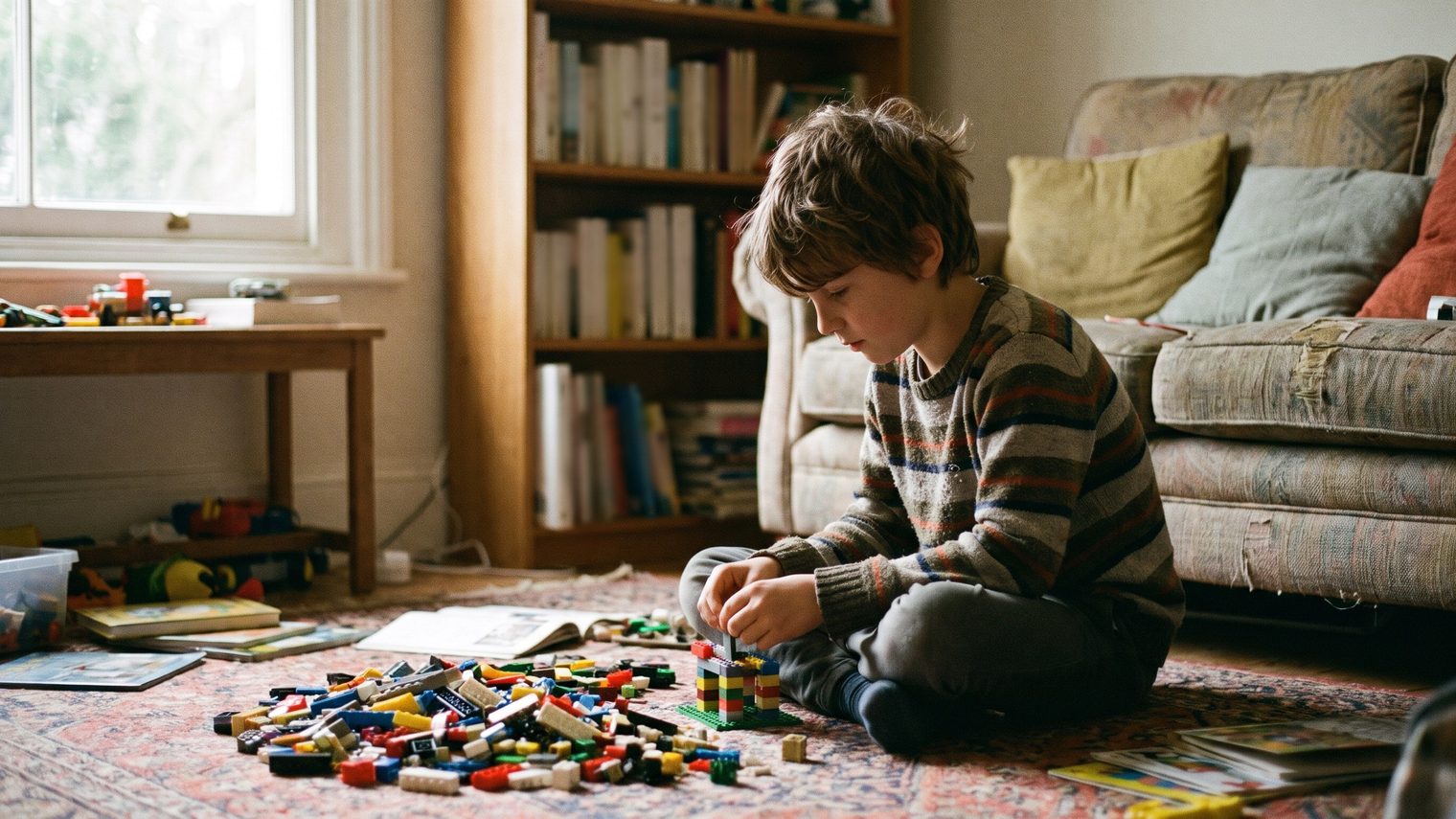
- Build something. Bricks, a cardboard box, tape and scissors. "Make a marble run" beats "go and play".
- Draw or make a comic. A pad and pens kept in one place. A strip of four boxes gives a story a shape.
- A den. A sheet over two chairs, a torch and a book.
- Bake from a card. A simple recipe they can follow with an adult nearby: flapjacks, pizza toast.
- Move indoors. The NHS Healthier Families site lists free games such as bin-hoop basketball, a sofa penalty shoot-out and cardboard-tube bowling.
- Look after something. Feed the pet, water the plants, sort a collection.
- A box of odd jobs. A jigsaw, a puzzle book, a magic trick to learn.
What can an 11 to 14-year-old do on their own?
Older children want things that feel like their own and lead somewhere. Ideas that suit them:
- A project with an end. Make a short book, a board game, a model, or a costume for a party.
- Cook a whole meal. Plan it, shop for it and serve it to the family once a week.
- Learn a skill by doing. Juggling, a song on an instrument, card tricks, knots, sewing a patch.
- Get out of the house. A walk or bike ride with a friend, the park, a kickabout. Ofcom found friends in person were the most named offline favourite.
- Build or fix something. An old bike, a bird box, a shelf for their room.
- Read. A shelf of their choice, including comics and graphic novels.
- Help out. Wash the car or help a grandparent in the garden.
Activity counts for a lot at this age. The UK Chief Medical Officers advise an average of at least 60 minutes of moderate to vigorous activity a day for children and young people. They also advise breaking up long spells of sitting.
What do I say when they say "I'm bored"?
Say less than you think. A long list of suggestions on the spot invites "no" to each one. Handing the screen back teaches that boredom ends with a screen.
Try one calm line, then step back:
- "That's OK. Have a look at your list and pick one."
- "Bored is fine. Something will come up. I'll be in the kitchen."
- "You can help me with dinner, or pick something from your list."
Then leave it for ten minutes. Most children find something once they see you are not going to fix it for them.
How do I make the switch away from a screen easier?
Have the next thing ready before the screen goes off. Most of the work happens earlier in the day.
- Make the list together. Sit down once and write ten ideas your child actually likes. Use their words. Stick it on the fridge.
- Put the kit out. Bricks on the rug, the pad and pens on the table, the ball by the back door. If it takes five minutes to find the glue, the idea is dead.
- Name the next thing before the screen goes off. "When this episode ends, it's the marble run." Ask them to choose it while they are still calm.
- Join in for the first five minutes. Start the drawing or set out the first brick, then drift off. Starting is the hard part.
- Keep the end of screen time the same each day. A known stop time means less to argue about. See what to say to "five more minutes" for that moment.
When is boredom a sign of something more?
Most boredom passes. If your child seems flat for weeks, and has stopped enjoying things they used to love, look more closely. The NHS lists signs of depression in children and young people. They include low mood that does not go away, irritability, tiredness, and not being interested in things they used to enjoy. If you are worried, book a GP appointment. The GP can refer to children and young people's mental health services.
Tomorrow, ask one question before the screen goes off: "What are you doing after this?" If the answer is "nothing", that is your list started. For how much screen time suits each age, read how much screen time by age. For the hour before sleep, read screens before bed.
Kairoo
Ideas for when they're bored, on their own phone.
In Kairoo, your child's app has an "I'm bored" button that gives ideas away from the screen. You and your child write the agreement together, both sign it, and Kairoo holds it.


Your phone and your child’s don’t have to match. Kairoo works between iPhone and Android, and your child’s app is also available on iPad.
Or start with the free agreement · Free, no card needed.
Questions parents ask
- Is it bad for my child to be bored?
- No. Writing in Psychological Review in 2018, psychologists Erin Westgate and Timothy Wilson describe boredom as a signal. Your attention is not engaged in something you value. It tells you to change what you are doing. Two small experiments were published in the Creativity Research Journal in 2014. People who did a dull task first came up with more creative ideas afterwards. A few minutes of boredom is part of finding the next thing to do.
- What can I replace screen time with?
- Start with what children already like. Ofcom asked UK 8 to 17-year-olds in 2026 for their three favourite free-time activities. Offline answers included friends in person (27%), pets (14%), being creative offline (13%) and time outdoors (8%). Add things that get them moving: the NHS Healthier Families site lists free indoor games such as bin-hoop basketball and a sofa penalty shoot-out. Let your child choose which ideas go on the list.
- What should I say when my child says "I'm bored"?
- Keep it short and calm, and hand the choice back. Try: "That's OK. Have a look at your list and pick one." Avoid offering the screen as the fix. Avoid a long list of suggestions on the spot. Psychologists describe boredom as a prompt to find something meaningful to do (Westgate and Wilson, Psychological Review, 2018). Your job is to make the next thing easy to start.
- How much physical activity does an 8 to 14-year-old need?
- The UK Chief Medical Officers published physical activity guidelines in 2019. For ages 5 to 18, they advise moderate to vigorous activity for an average of at least 60 minutes a day. They also advise breaking up long periods of sitting with at least light activity. The NHS Healthier Families site repeats the 60 minutes.
- When is boredom a sign of something more?
- When it lasts and comes with other changes. The NHS lists signs of depression in children and young people. They include low mood that does not go away, irritability, tiredness and losing interest in things they used to enjoy. If your child seems flat for weeks and has lost interest in things they loved, book a GP appointment. The GP can refer to children and young people's mental health services.
Read next
Sources
- Children and Parents: Media Use and Attitudes Report 2026, Ofcom, 21 May 2026
- UK Chief Medical Officers' Physical Activity Guidelines, Department of Health and Social Care (GOV.UK), 7 September 2019
- Does Being Bored Make Us More Creative?, Mann and Cadman, Creativity Research Journal 26(2), 165-173, 2014
- Boring thoughts and bored minds: The MAC model of boredom and cognitive engagement, Westgate and Wilson, Psychological Review 125(5), 689-713, 2 July 2018
- Free indoor activities for kids, NHS Healthier Families
- Depression in children and young people, NHS, 16 May 2023
Last reviewed 25 October 2026. Kairoo checks these pages when the rules or the research change; if you spot something out of date, tell us at hello@kairoo.family.