Guides · The research
How much pocket money should a 10 to 13-year-old get in the UK, and should it be tied to chores?
Your child says a friend gets £10 a week. You don't know if you are mean or soft, or whether emptying the dishwasher should earn money at all. Here are the typical amounts by age in the UK, what the official money guidance says, and what the research says about paying for chores.
Key fact
£4.01
a week is the average regular pocket money for a 12-year-old, before chores and extras
In short
Pocket money averaged £3.27 a week at 10 and £4.50 at 13 in 2026; a fixed base plus paid extra jobs covers saving and earning.
There is no right amount. The most recent UK figures come from NatWest Rooster Money's 2026 Pocket Money Index. It covers more than half a million children on its card and app, from March 2025 to February 2026. Regular weekly pocket money averaged £3.27 at 10, £3.56 at 11, £4.01 at 12 and £4.50 at 13. With chores and extras added, the totals were £6.08, £7.30, £9.15 and £11.50. These are averages from families on one app, so use them as a rough guide. MoneyHelper, the government-backed money guidance service, says the amount depends on what you can spare and your child's age. On chores it leaves the choice to you. Many families do both: a fixed base, plus extra jobs paid at an agreed price.
Key facts
- Regular pocket money averaged £4.01 a week at 12 and £4.50 at 13, before chores and extras (NatWest Rooster Money, 2026).
- Of families on that app with a regular allowance, 34.8% make it depend on chores (NatWest Rooster Money, 2026).
- 88% of UK 7 to 17-year-olds would ask their parents for money advice (Money and Pensions Service, 2022 survey of 4,740).
Saturday morning. "Can I have some money? Everyone else gets £10 a week." You have no idea if that is true. You also can't decide whether it should come with jobs attached. And if you pay for the bins, will the bins ever get done for free again? It is easy to set pocket money by guesswork and then argue about it for years. A few facts and one agreed plan make it much simpler.
How much pocket money do 10 to 13-year-olds get in the UK?
The most recent UK figures are from NatWest Rooster Money's Pocket Money Index, published in June 2026. It uses the payments of more than half a million children on its card and app, from 1 March 2025 to 28 February 2026. Here are the weekly averages for 8 to 14-year-olds. The first figure is regular pocket money alone. The second adds money for chores and other extras.
- Age 8: £2.88 regular, £5.10 in total
- Age 9: £3.07 regular, £5.52 in total
- Age 10: £3.27 regular, £6.08 in total
- Age 11: £3.56 regular, £7.30 in total
- Age 12: £4.01 regular, £9.15 in total
- Age 13: £4.50 regular, £11.50 in total
- Age 14: £5.10 regular, £13.97 in total
The regular amount rises slowly, by about 30p to 50p a year. The total rises much faster. Between 11 and 13, regular pocket money goes up by 94p a week, while the total goes up by £4.20. The gap suggests that, as children get older, more of their money comes from chores and extras.
Read these figures with care. They are averages from families who chose a money app, and they are not a random survey of UK households. Only 27.4% of families on the app had a regular allowance set up at all. So "£4.01 at 12" tells you what is normal on one app. It does not tell you what your child should get.
What does MoneyHelper say about how much to give?
MoneyHelper is the free money guidance service run by the Money and Pensions Service, which is backed by the government.
- There is no right amount. It depends on how much spare money you have and how old your child is.
- Move money you already spend. If money is tight, some of what goes on sweets, treats or toys could become pocket money instead.
- Agree what it is for. Talk with your child about what pocket money has to cover. That might be treats and toys, trips out, clothes, phone top-ups or presents for family and friends.
- Pay it regularly. Regular money is what teaches saving and budgeting. Weekly suits younger children. A monthly amount teaches older children to budget over a longer stretch.
- Plan the rises. A birthday or the move to secondary school are natural points to increase it.
- Let them get it wrong. Small amounts let children make mistakes cheaply and find out what doesn't work.
Are money habits really set by age seven?
You may have read that children's money habits are formed by seven. The line comes from a 2013 review for the Money Advice Service, written by David Whitebread and Sue Bingham at the University of Cambridge. The review collected earlier studies of how young children learn. It did not follow children into adulthood.
What it says is narrower. By about seven, several basic money ideas are usually in place, such as knowing that a coin's value is not its size. By about eight, most children can judge how far away a future date is. Saving depends on that. The review also cites research finding that children only understand pocket money as a regular income in early adolescence.
For a parent of a 10 to 13-year-old, that is good news. Your child is now old enough to plan, wait and make real choices with money.
Should pocket money be tied to chores?
There are three common set-ups. Each teaches something different.
- A fixed amount, with no strings. This teaches budgeting and saving. Chores happen because everyone in the house helps. The weak point is that it does not link effort to money.
- Money for each job done. MoneyHelper says this teaches that money usually has to be earned, and children may do more chores. The weak point, as MoneyHelper also says, is that it may not fit if you want help to come because they live there. A child who doesn't need money that week can simply stop.
- A mix. A fixed amount for being part of the family. Everyday jobs, like clearing their plate or tidying their room, are unpaid. Extra jobs beyond the everyday are paid, at a price agreed in advance.
In the 2026 index, 34.8% of families on the app with a regular allowance made it depend on chores. Outdoor jobs paid the most: mowing the lawn earned £3.52 a time on average and washing the car £3.36. Making the bed earned 28p.
What does the research say about paying children for jobs?
We could not find a UK study that compares these three set-ups. The closest evidence comes from psychology experiments on rewards.
A 1999 review in Psychological Bulletin pooled 128 experiments. When people expected a tangible reward for doing a task they already found interesting, they did less of it afterwards by choice. The effect was stronger in children than in university students. Positive feedback had the opposite effect.
A 2008 study in Developmental Psychology looked at toddlers of 20 months. Those given a small toy for helping an adult were less likely to help again than those given praise or nothing.
Neither study tested pocket money for housework. The pattern still points one way. Paying for help that a child would give anyway may make that help depend on the money. That is a reason to keep everyday family jobs unpaid and to pay only for real extras.
How do you set up pocket money so it doesn't become a weekly argument?
- Agree the amount and what it covers. Write both down. "£4 a week, for snacks out, game top-ups and presents for friends" settles a hundred small requests in advance.
- Pay on a fixed day. Saturday morning, every week, without being asked. If you forget, they learn it is negotiable.
- Decide which jobs are unpaid. List the everyday ones. These are part of living in the house.
- Price the extra jobs. Washing the car or clearing the garden can have a set price. Agree it before the job starts.
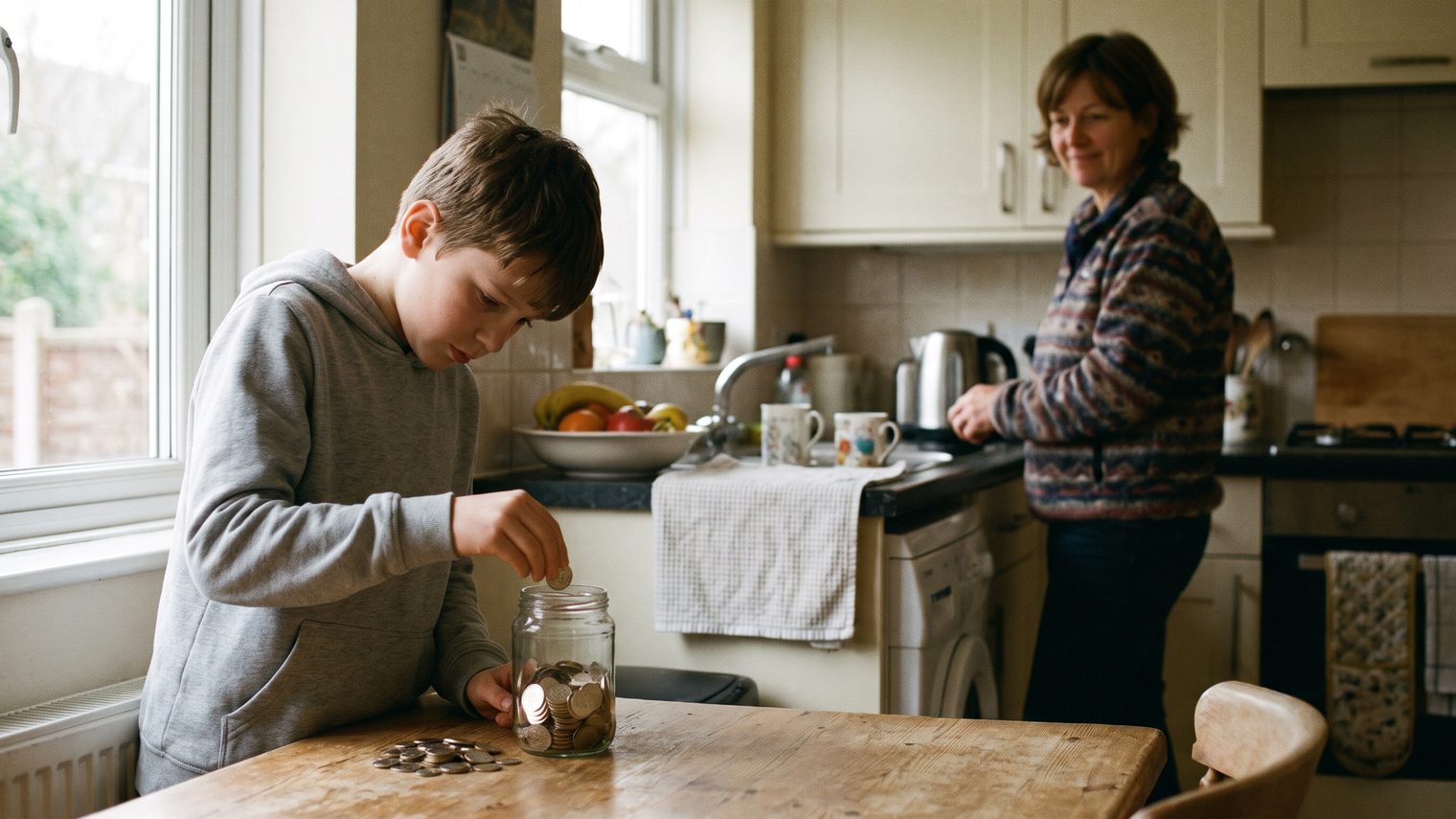
- Let them save towards something. Pick a goal together, write the price down, and work out how many weeks it will take. A jar they can see works well at this age.
- Don't top up after a mistake. If the money is gone by Tuesday, it is gone. A wasted £4 at 11 is a cheap lesson.
Why talk about money as well as giving it?
Children want to learn this from you. The Money and Pensions Service surveyed 4,740 UK children aged 7 to 17 in 2022. 88% said they would ask their parents for money advice. Just over half of parents said they felt confident talking to their children about money. Pocket money gives you a weekly reason to have that conversation.
As children get a phone, the money talk moves online. For 9 to 11-year-olds, MoneyHelper suggests talking about phone credit, gift cards and the fact that money spent inside a game usually can't be refunded. If a first phone is coming, read what age should a child get their first phone.
Pocket money works best as one part of a family agreement. To write one that also covers chores, homework and phones, read how to write a family screen time agreement. If the daily fight is about homework, read homework before screens.
Kairoo
Extra jobs, priced before they start.
In Kairoo you add extra jobs and set what each one is worth. Your child picks one or suggests their own, you check it, and it earns coins. Coins buy Roo new looks, or become pocket money if you switch that on.


Your phone and your child’s don’t have to match. Kairoo works between iPhone and Android, and your child’s app is also available on iPad.
Or start with the free agreement · Free, no card needed.
Questions parents ask
- What is a reasonable allowance for a 12-year-old?
- In NatWest Rooster Money's 2026 Pocket Money Index, 12-year-olds on its app got an average of £4.01 a week in regular pocket money. With chores and other extras added, their average total was £9.15 a week. The data covers March 2025 to February 2026. MoneyHelper, the government-backed guidance service, says there is no right amount: it depends on what you can spare and what the money has to cover.
- What age should kids get pocket money?
- MoneyHelper suggests small amounts of pocket money from about five or six, to help a child save up for something they want. A 2013 review for the Money Advice Service, by two Cambridge researchers, found several basic money ideas are usually in place by seven. The same review says children only grasp pocket money as an income in early adolescence. That makes 10 to 13 a good age to hand over real choices.
- Should pocket money be tied to chores?
- MoneyHelper leaves it to you. Paying for chores teaches that money usually has to be earned. It may not suit you if you want your child to help because they live there. In NatWest Rooster Money's 2026 index, 34.8% of families on the app with a regular allowance made it depend on chores. Many families split it: a fixed amount, everyday help unpaid, and extra jobs paid.
- Does paying for chores stop children helping for free?
- It can. A 1999 review of 128 experiments in Psychological Bulletin found expected rewards made people less keen to keep doing a task they enjoyed. The effect was larger in children. In a 2008 study, 20-month-olds given a toy for helping helped less afterwards than those given praise. Neither study tested pocket money for housework. Keeping everyday family jobs unpaid and paying only for extras is one way to lower the risk.
- Should pocket money be weekly or monthly?
- MoneyHelper says the key is paying regularly, because that is what teaches saving and budgeting. It suggests weekly for younger children. As they get older, a monthly amount teaches them to budget over a longer stretch. When to switch is up to you.
Read next
Sources
- NatWest Rooster Money's Pocket Money Index 2026, NatWest Rooster Money, June 2026
- Mow Money, No Problems: 'Great Out-Chores' Boost Kids' Pay Packets According to NatWest Rooster Money's 10th Annual Pocket Money Index, NatWest Group, 30 June 2026
- Pocket money and saving, MoneyHelper (Money and Pensions Service), checked 25 October 2026
- Learning about money by age, MoneyHelper (Money and Pensions Service), checked 25 October 2026
- Habit Formation and Learning in Young Children (Whitebread and Bingham, University of Cambridge), Money Advice Service (archived by The National Archives), May 2013
- UK Children and Young People's Financial Wellbeing Survey (2022 wave), Money and Pensions Service, Financial Wellbeing Evidence Hub, 2023, updated 17 September 2024
- A meta-analytic review of experiments examining the effects of extrinsic rewards on intrinsic motivation, Psychological Bulletin 125(6), Deci, Koestner and Ryan, 1999
- Extrinsic rewards undermine altruistic tendencies in 20-month-olds, Developmental Psychology 44(6), Warneken and Tomasello, 2008
Last reviewed 25 October 2026. Kairoo checks these pages when the rules or the research change; if you spot something out of date, tell us at hello@kairoo.family.